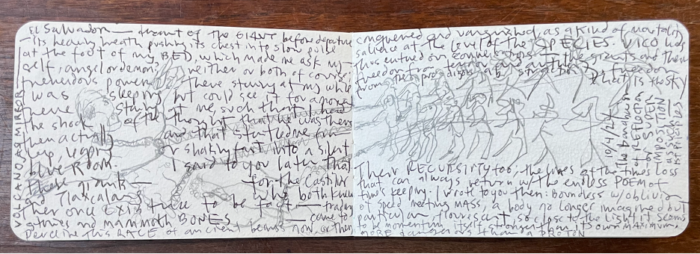
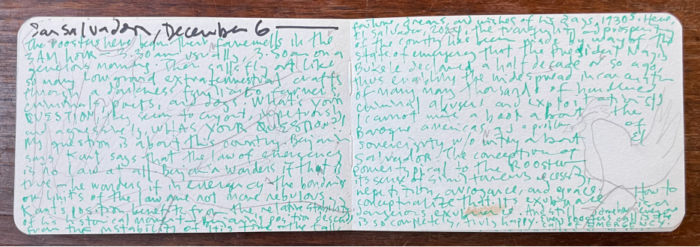
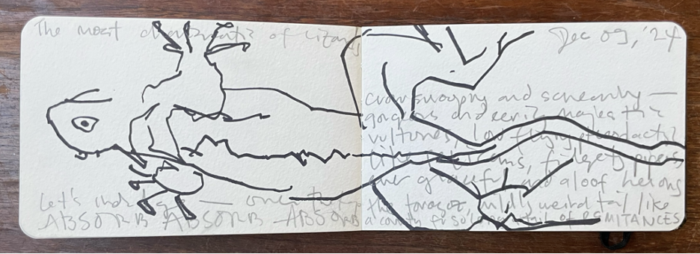
BORDERS (Part II) Border abolition now! Time expands and contracts. The twenty-first century after and between Trump’s inauguration and inauguration blinks—on and off, off and on. The long tail of a tale until tal cual “she sat in her […] room, sharpening…” BORDERS II bookends borderS I (issue #08), but does not foreclose it; […]
Time expands and contracts. The twenty-first century after and between Trump’s inauguration andinauguration blinks—on and off, off and on. The long tail of a tale until tal cual “she sat in her […] room, sharpening…” BORDERS II bookends borderS I (issue #08), but does not foreclose it; once again recognizing the anecdote as pharmakon, as dream and wake-up call, as cartas despedidas, as a child, rearing out from under their mother’s shift (x2) until alter-kinning is realized as a mutual, mutating gif(t). Imagined Theatres entries usually follow a set template. A “theatre” is staged; a “gloss” is “solicited” in response. For this issue, from the jump, we dissolved the divide between “theatre” and “gloss,” pre-pairing and thus preparing contributors to practice border abolition formally. Contra-zombification—from political paralysis to the resuscitation of zombie laws haunting our presents—we categorically rejected a priori readings of Trump 2.0 that cue up the tears of laughter in Karl Marx’s “The Eighteenth Brumaire of Louis Bonaparte” (“history repeats itself first by tragedy, second by farce.”)
Nope.
Ahead of the Winter 2025 Los Angeles Fires, the US-wide state-side and offshoring of migrant detention, the Summer 2025 San Diego South Park resistance to ICE agents, the National Guard’s LA occupation, the planetary mobilization of millions without “Kings,” the amplified syncing of Israeli and US war machines, bunker-busting preemptively… we invited ten sets of cultural workers to contemplate collaboration, to co-create gestures in/around/about/against “borders,” broadly defined), in the spirit of spatial disobedience or revived claims (think President Claudia Sheinbaum’s declaration that Mexico would be happy to build a wall along the international boundary line established by 1830 maps of North America). We asked artists, writers, thinkers to make work despite devaluations of joy, in the face of ongoing Administrations of Fear. The resulting ten hyphenated theatres-glosses unfold in a multilingual, intermedial range of formats from journaling to poetry, two-acts ‘n’ special scenes, sketches, video performances, micro-fabulation (birds are real!), “fake news” headlining “mutie” forces folding forward into the eighth dimension.
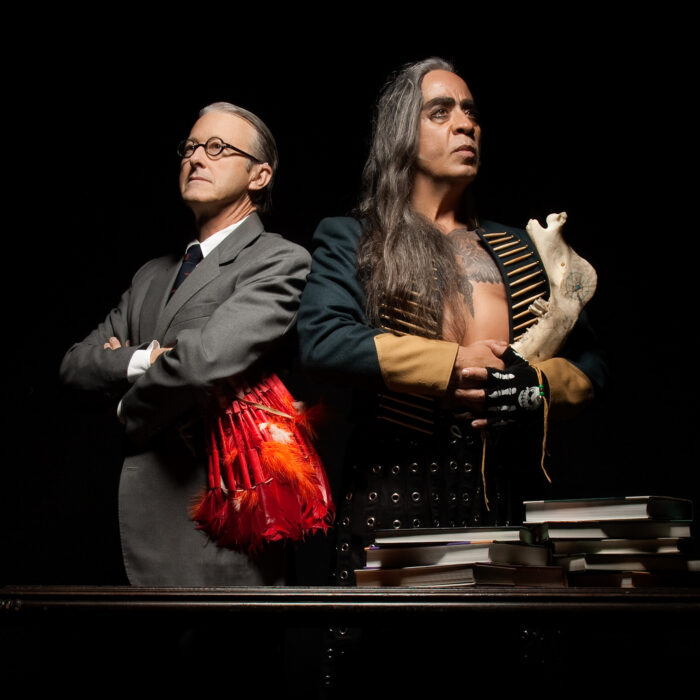
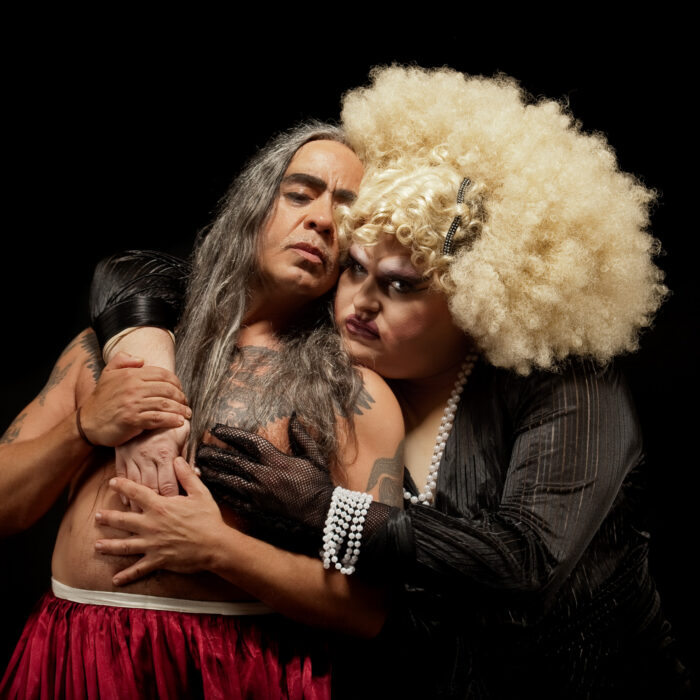
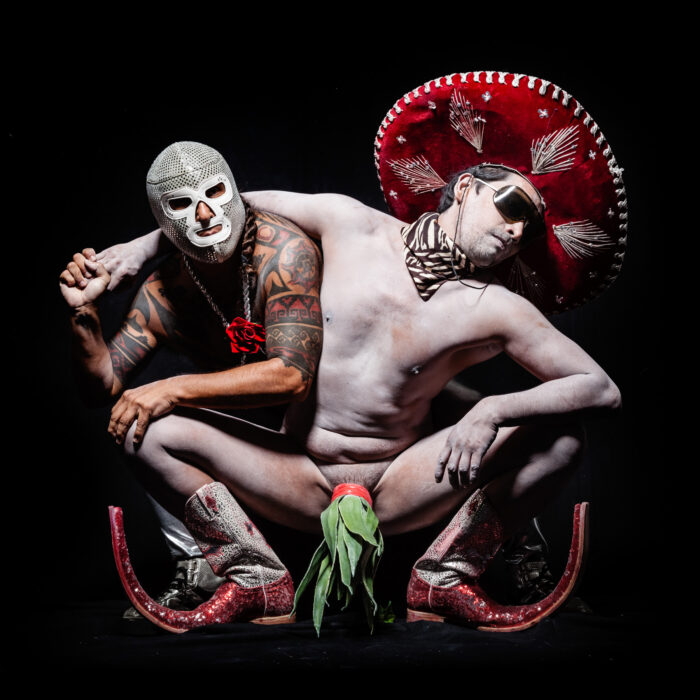
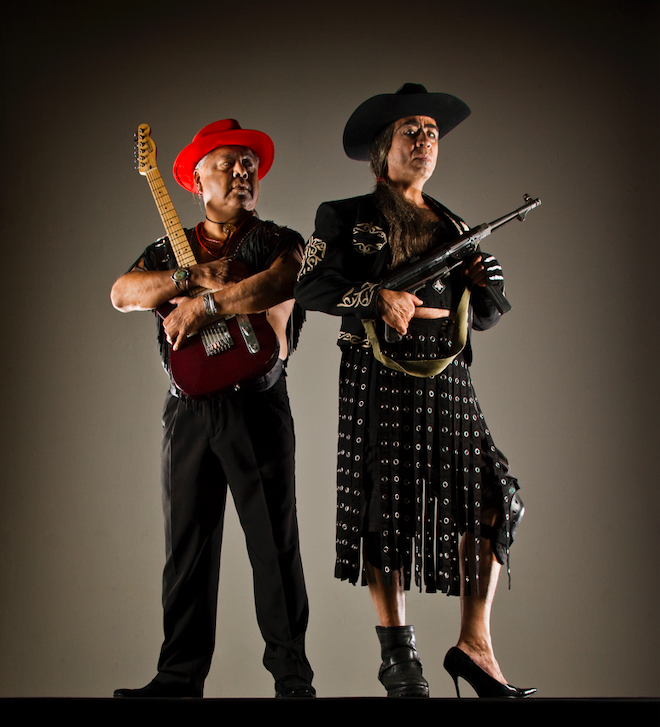
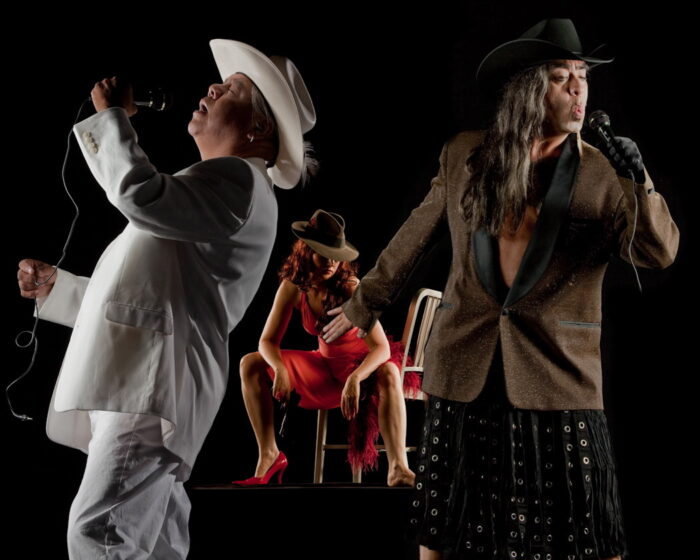
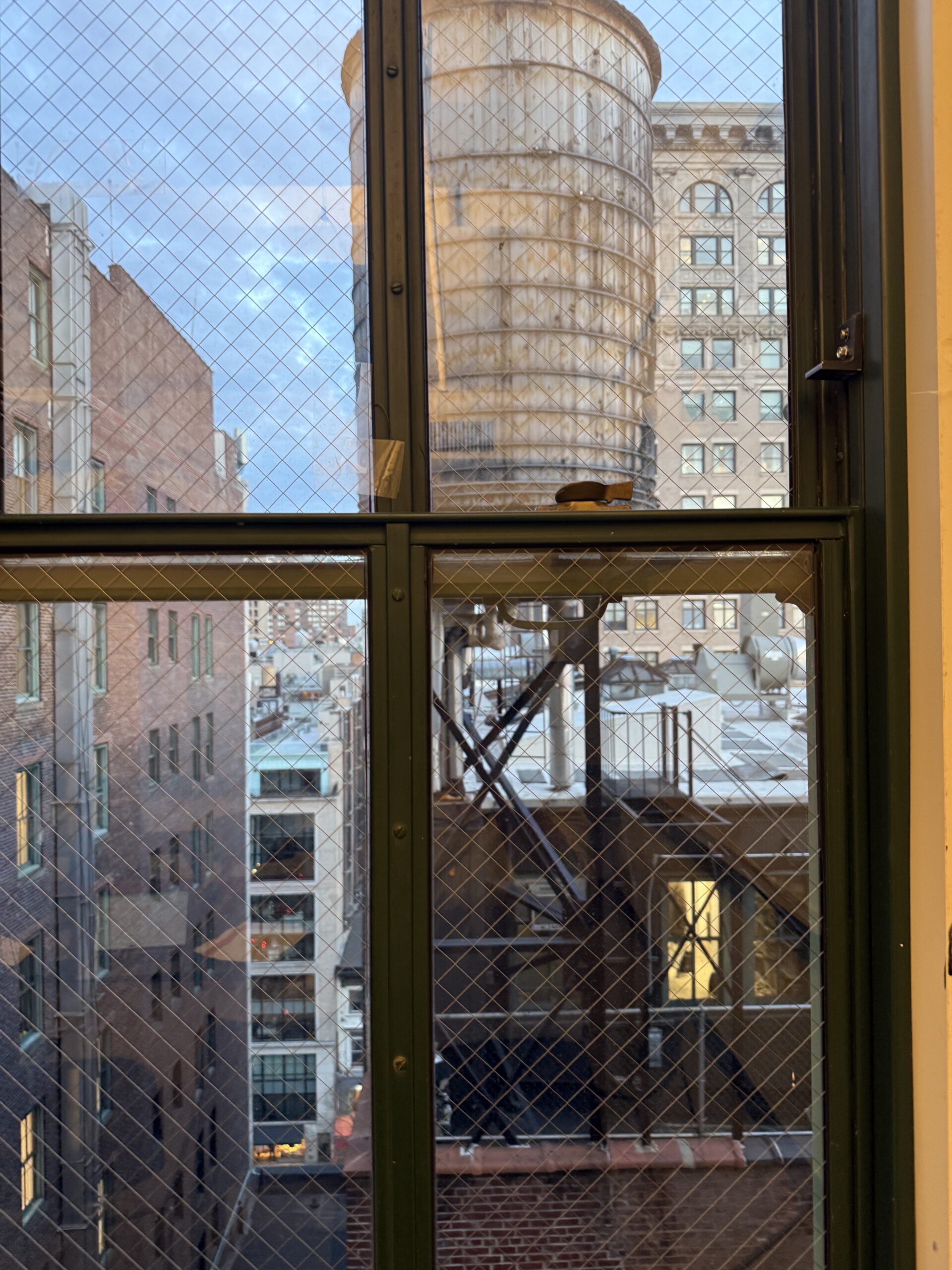
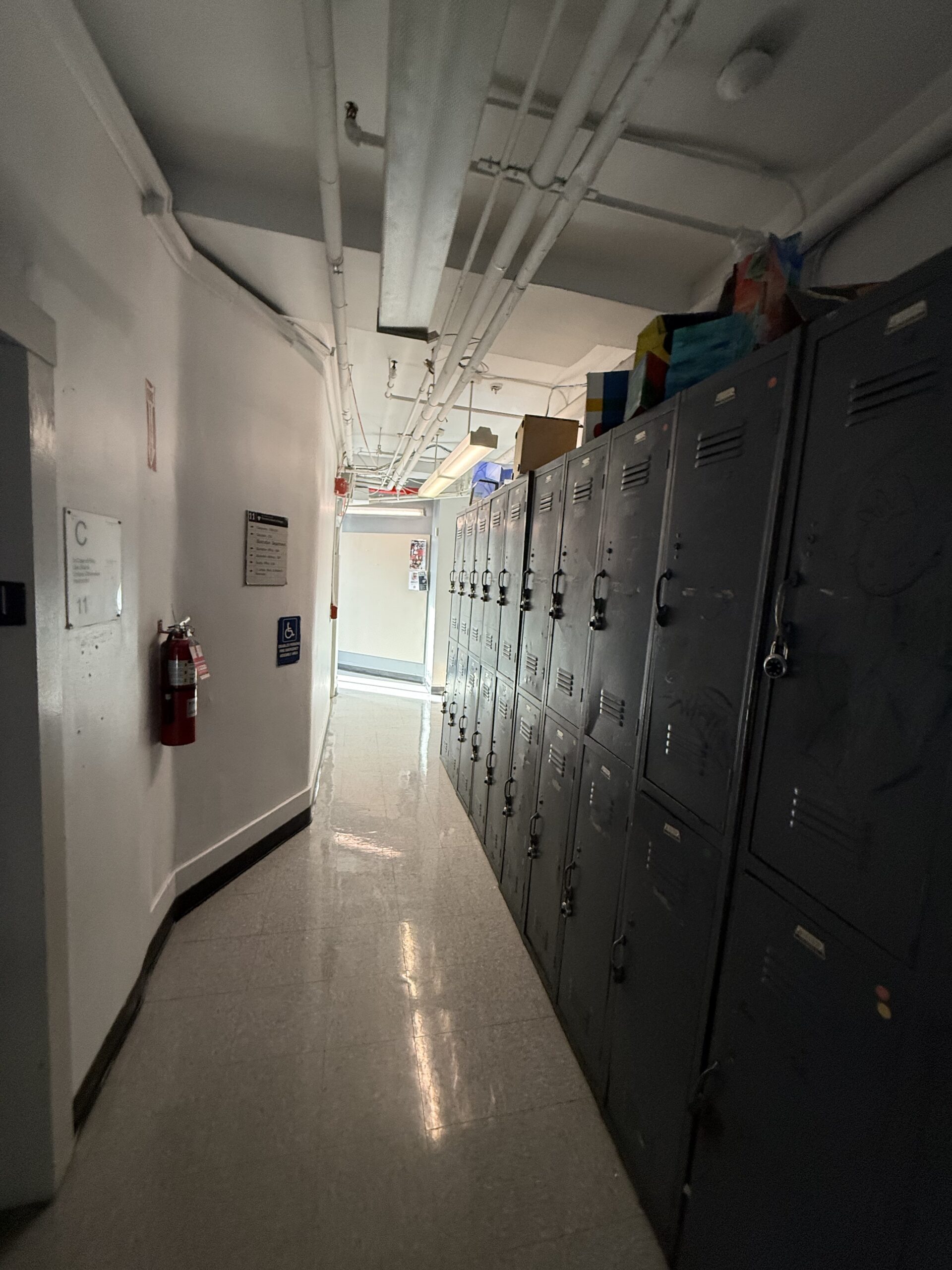
Say your goodbyes. Wake up with Guillermo Gómez Peña and Balitronica Gómez from “el hamlet fronterizo” love poem. Sing along with Alexandro Segade and Malik Gaines’s found-farewell to Ché Guevara (at the very least, join the “coro” or refrain from inaction). Go birding with Lily Hoang; nose-dive into a dilated bird’s-eye-view (in anticipation of the aerial cartographies mapped out by Estudio Teddy Cruz + Fonna Forman and Daniel Borzutsky), become a “citizen of The Night” with Jackie Wang. “The specters within do not wane”: Home in on the local with Renate Ferro and Tim Murray on the trail of abolitionist and Indigenous geographies back to the future. Get on track with Laura Pérez León and Amie Parry to approach the “border dilemma” as that which necessitates a refusal of both “self-ethnicizing appropriation and the reification of cultural difference as mutually constructed border affirming projects of the ongoing Cold War.” Watch Nature overtake Nation in the “MEXUS” of Cruz and Forman’s docu-visualizations of a border’s always-already slow biodrift. Catch a glimpse of our collective “efflorescence” in photographs of liminal institutional spaces or thoughts casting shadows in Jennifer Firestone and Wendy Xu’s dialogical image-text meditations. To borrow a line (or two) from Borzutsky, “[r]ecite poems about the block of ice” that straddles the “state before the State/s;” catch the strain of “irresistible music of morning birdsong,” counter-harmonizing with Hoang and Wang’s parables of de/flocking, in Edgar Garcia’s bath-tub dreamin’ (“forever more for having tasted the fruite”—“a wedge or edge into Milton”). Fangs, talons, and talents at the ready, bio-hack with micha cárdenas; go with the flow of Allucquére Rosanne “Sandy” Stone’s trans-futuristic, chyron-ic newsfeed. Then, doubling down on Kaprow-Antin-esque “child’s play,” measure for measure, revel in the unboundedness of microchimerism (the word and worlds we didn’t know we were looking for in the Chthulucene’s primordial goo!), register the “heavy-handed” coincidence of chromatic synchronicity per the rhyme of the Egretta tricolor and the US, Norwegian, and Dominican flags in Las Hermanas Iglesias y familia’s gallery of shape-shifting peek-a-boos and face-painting.
“Sisterhood is powerful,” and then some.
If the 404 file re/appears, don’t be afraid to read, “Democracy is not found here.” In the immortal words of Woody Guthrie, these fascists are “bound to lose.” Reload and refresh, keep on keeping on, arc like a rainbow—we’re in it to win it—the long game.
Goodbye America, me voy. Adios Estados Undidos en el Temor. Adios soldados, Terminators, War on Terror
Adios guerreros de gimnasio, patriotas histéricos, demonios de la Banca, demócratas cobardes. Ahi los wacho desde abajo
Me voy al sur, me pinto, Señor Trump, a, a, a…
Adios Gringolandia sitiada, my second home & third country, mi casa en llamas…
Adios racistas aterrados, asesinos en serie de televisión, comerciantes del pánico, acteurs de la méta-réalité
Adios celebridades de la estupidez X-trema; banqueros y vaqueros con tupeé de peluche tipo naranja eléctrica… Me voy al sur, me pinto, señor Trump-a-dios-a dios y a todos ustedes
Adios a tu privilegio imaginario, a tu maltrato cotidiano; goodbye
indiferencia, desconecte, racismo non-plus-ultra, violencia PLUS o mois, adieu, capice… Me pinto al revés en el espejo
Adios tecnologias inútiles… Texting, texting, HTP—309-BH1, 500 canales Plus
Adios I-phone, I-pod, I-tunes, I-chingao, I-am leaving for good. Me voy al sur del sur y no regreso; ni siquiera a mi propio funeral
Goodbye in German “Tschuss,” (sshhhuz), zic hail, me pinto, señor Trump, zic hail!
Goodbye vendedores de catástrofes, constructores de muros imaginarios, policias de la injusticia protestante. Adios a todos, chan, chan. Me voy al sur y valga la redundancia, a un país de mierda que aún no existe… y nunca existirá
Se llama bla-bla-bla & bla-bla-bla & bla-bla-bla & A can’t astap aspakang laik a pancha maxacan A Kant halp at all caraja!”
& I’m not a nationalist. You know me. So, why do I speak Spanish and glitch in my dreams?
I woke up this morning and realized this was just a nightmare,
a weird self-deportation nightmare.
It’s just my fears acting out.
How lucky I am!!!
How lucky we think we are, que no?I’m getting my sleep apnea night mask on Craigslist.
El Hamlet Fronterizo:
Weird Love poem in Spanglish
(Playas de Tijuana, 1988)


Border State Park;
Facing the formidable Pacific ocean
w/one foot on each country
I talk to my other self
a dos voces interiores:
“me ama/ no me ama
me caso/ no me caso
me canso/ no me canso
chicano/ mexicano
que soy o me imagino
regreso o continúo
me mato/ no me mato
en Mexico/ in Califas
to write or to perform
en Inglés or in Spanish…
I hate you; no, I forgive you,
no, I crave for you, mi loca
ansiosamente tuyo,
de nadie más
frontera mediante…
te espero, mi chuca,
te sigo esperando…
you are it, tu llanto,
tu make-up, tus cicatrices,
(pause)
no, you are definitely not it
you don’t even exist yet"
Letras por Che Guevara, adaptado por Alexandro Segade

Haciendo un recuento de mi vida
Mi única falta de gravedad
Es no confiar más en ti

He vivido días magníficos a tu lado
Las noches luminosas y tristes
Una mezcla de alegría y dolor

Te podría decir que te extraño
Pero sé que no me creerías
Aunque la morriña avanza incontenible

CORO:
 	Me recuerdo en esta noche
	Pasamos un día preguntando
	A quien se debía avisar
	En caso de muerte
	Se triunfa
	O se muere
 	En una revolución

No era fácil entenderme
Me dirán aventurero y lo soy
Solo que de un tipo diferente

No sabes cuánto te extrañé
Y tus lágrimas rituales
Bajo estrellas nuevas

En la hora definitiva
Bajo otros cielos, mi último
Pensamiento era para ti

CORO:
 	Que no dejo
 	A mis hijos
 	Nada material
 	No me apena
 	Me alegra
 	Que sea así
The whole congregation judges him, the new guy. They say he’s cocky—hardy har the irony, of course, being that he, like everyone else here, lacks external genitalia—and they have a million more complaints about him, too, starting with each and every feather on his body. Count them up, and maybe it’s not a full million, but who has the patience to go counting feathers?
Birds, unlike humans, are not racist, but that doesn’t delete discrimination.
Birds, unlike humans, don’t vote, but they like to keep up with the current.
Like when the new guy first appeared, the reddish egret asked if he was heading to a tea party.
And when the new guy next appeared, a black-bellied plover made a joke about his being the wrong wing. The waders gave him a polite chuckle, just as a gesture of solidarity. They got the joke, they did; it just wasn’t funny. He’s funnier when he’s got on his non-breeding suit, but it’s early July: his belly is inky and his humor falls shorter and shorter with every try.
And when the new guy next appeared, a curlew pointed to the coat room, wouldn’t want to muddy his patriotism. This made the flock erupt, laughing so hard they were gulping.
Still, the new guy keeps appearing. He knows how this goes. It’s not like he fledged yesterday. Shore birds are snide—they’re assholes, really—but this mockery will abate. Surely, it will; it must. This won’t go on forever, right?
One morning, while the new guy is off finding breakfast, the birds call emergency congress. Mostly, it’s petty shit, nothing that would merit punishment, much less banishment, which is the tacit goal. They’ve been strategizing for more than an hour, and the tide pushes deeper into the mud. Grumpiness increases with hunger; dawn has broken to morning, and the breakfast buffet is digging down and down. Their beaks feel parched, aching to thrust into the cool wet sand.
At last, a solitary sandpiper peeps, “Enough, enough. Not a single bird has offered a single reasonable reason, and without just cause, we cannot ask him to—”
Before, the congress had been respectful, reasonable, at least towards one another, but now, suddenly, before the little sandpiper could finish his sentence with all its implications, all the birds squawk at once. It’s an unbearable sound, worse even than a cotillion of terns, a highness of royals in formation. Now, everyone has an idea, and every idea is more desperate than the last. Accusations are thrown about, lies and fairy tales and tales taller than the tallest snowy.
In the midst of all the raucous, the tricolored heron returns, lands right in the middle of the pandemonium—and before his wings can fold back into place, everything stops: the birds, the squabbling, all the fun and games. All the birds turn and stare. The tricolored cranes his neck, looks every shorebird present in the eye. His blinks feel heavy and deep, the nictating membrane slides horizontal and back, but it’s useless. One fat teardrop hits the brackish water, and every bird could hear it burst. And then another one falls. But before a third can pop, the tricolored opens his rufous wings, and the congress of birds watches the white strip of his belly fly east. The sunlight emphasizes first slate, then rust, first cornflower, then ruby: what a marvelous show!
That night, the sky alights with booming rage. The tricolored never returns, but every year on the anniversary of their unkindness, exuberant red, white, and blue siege the air—bursting, hot, a lamentation.
They say astronauts, upon viewing Earth from space, experience the “overview effect”—a sublime sensation induced by the perception of Earth as a unified whole, an undivided system without borders. From the distanced vantage point, borders are rendered utterly absurd.
Try explaining borders to a bird. They travel without papers because the sky has no sovereign; they carry lost souls to the afterlife, brazenly crossing the most securitized of all borders. They are residents of everywhere, of nowhere, hollow-boned creatures opportunistically riding wind currents, in flocks that render visible rising columns of air.
*
At dusk, years after the infamous congress, when the regal tricolored heron vanished from the pond, the black-crowned night heron became the guardian of the swamp. Nycticorax nycticorax—“night raven” in ancient Greek—was a species found on every continent except Antarctica and Australia, whose sole citizenship was The Night.
Perched on the edge of the water, on the concrete embankment, the Nycticorax stood stock-still, seemingly hunched, staring at me with one red-ringed eye. Perhaps because it bore an uncanny resemblance to the eponymous heron in the Hayao Miyazaki film The Boy and the Heron (except for the neck—its neck was stout), I silently asked the Nycticorax where he planned to take me.
“The door…”
Yes, the pond was a door, one that opened only at the crepuscular hour.
“In it you will see…the death of your mother.”
“What?”
“Just kidding—this isn’t a Miyazaki film, you fool!”
The Nycticorax was trolling me.
“Are you the simorgh I’ve been looking for…all this time?”
“Pssh—enough with this cryptid hogwash! Did you really believe you would find answers to your metaphysical questions in a Florida marsh?”
“Should I consider you then…a bird of ill-omen?”
The Nycticorax looked heavenward, opened its beak, and began gagging…croaking, gutturally. Then it turned to me and vomited up a half-digested fish, which it thrust toward my feet. Never had I smelled anything so foul.
“Nobody understands me. When I crossed into this realm, the misnomer became my name.”
“And your eyes?”
“The story of my eyes? When I was a juvenile, they were yellow. My red eyes reflect light, enabling me to see at night, whereas you see only gradations of shadow.”
The Nycticorax continued to gaze at me through a single vampiric eye.
By then, it was night.
“Make me a citizen of the nuktos!” I cried to the air.
The Nycticorax began to disappear. In its place there was only the red-ringed eye, resting like a marble on the pavement.
The eye began to swell until it was the diameter of a sewer lid. The red ring began to turn, cutting a hole in the fabric of reality like a cosmic can-opener. As it inched clockwise, a seam of red light grew until the circle was complete and the fragment of Florida that had been hole-punched fell soundlessly into the pond.
The portal opened.
I jumped into it. And that is how I became a citizen of The Night.
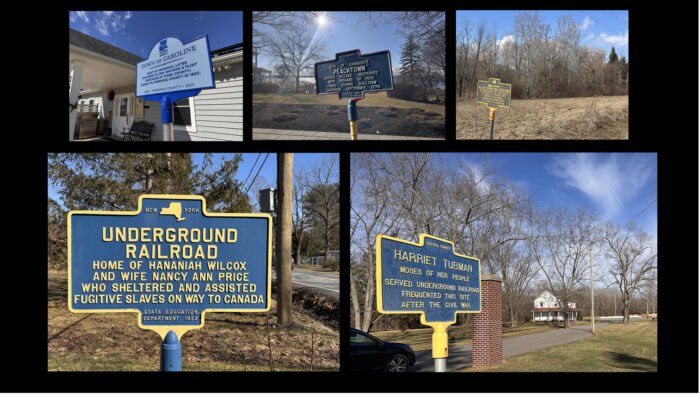
As residents of Upstate New York we are marked by the fraught specters of the border and enemy within. Trump’s antagonistic struggle with neighboring Canada, 170 miles north, summons the complexity of the disturbing phantoms haunting the land on which we live. From New York to Canada, the fraught apparitions of the rent promises of history arise at every crossing.
Historic road signs about one mile from our home, mark our rural town’s prideful acknowledgement of its Haudenosaunee heritage. We think back to the open Indigenous Territories when the waters and lands on either side of the St. Lawrence River served as shared grounds for the Six Nations of the Haudenosaunee (Iroquois) Confederacy. Vibrant cherry orchards and four sister’s gardens provided plentiful provisions along with the fruits of territorial hunting and fishing.
These are now distant memories rendered unstable by disturbance of the utopic visions of the past. Today, one of the sacred burial grounds of the Haudenosaunee Confederacy remains unceremoniously covered by the original nineteenth-century buildings of Cornell University. Other signposts across our Finger Lakes Region mark the prior savagery of the 1779 Sullivan Campaign that aimed for the “total destruction and devastation” of Haudenosaunee settlements. Following the destruction of their vibrant villages and peoples, the remaining Haudenosaunee were then restricted to six miles on each side of the St Lawrence River by the Halimand Treaty of 1784, which now constitutes the border of Canada and the US.
The specters within do not wane. Right down the road from our house are New York historic signs marking the slave graveyard in our community’s backyard. In contrast, across the county are the more heroic markers in front of nineteenth-century homes. Everyday citizens, from Hanniah Wilcox and Nancy Ann Price in Freeville to Harriet Tubman in Auburn, bravely harbored those fleeing the traumas of the enslaved.
What is now Trump’s contested border of trade and profit has served both as the remaining territory of the Haudenosaunee as well as the aspirational goal of the prior routes of the Underground Railroad and the subsequent resistance to the Vietnam draft. Just as our homestead marks the violent legacy of its history, Canada served then, as it does now, as the contrasting beacon of hope from the enemy within.
Note: This work integrates theatre and gloss into a single piece, which was subsequently broken apart again for the purposes of publication. The two pieces, re-established “theatre” and “gloss,” thus document a performative dialogue in which each author invited the other to act in specific ways; and, the dissolution and reconstitution of generic borders. Laura Pérez León’s text is in plaintext; Amie Elizabeth Parry’s text is in italics.
The Diccionario de la Lengua Española defines ‘dilema’ as: “Situación en la que es necesario elegir entre dos opciones igualmente buenas o malas.” In philosophy, the term is defined as: “Argumento formado por dos proposiciones contrarias disyuntivamente, de tal manera que, negada o concedida cualquiera de las dos, queda demostrada una determinada conclusión.” Synonyms of ‘dilema’ include: disyuntiva, alternativa, problema, duda, encrucijada, opción.[1] Antonyms encompass solution, certainty, straightforwardness, effortlessness, no bother, no trouble.
First Act
For this exercise, we initially use the term ‘border’ as ‘dilemma’ aiming to reflect on self-perception and perception of other peoples as cultural and linguistic phenomena.
A border understood as a dilemma is a situation of crisis in which we must choose between monolithic, uniform, developed, rigid notions of culture.
However, culture is a non-monolithic entity:
“[…] I have also developed arguments against a monolithic conception of culture and its shared hermeneutical resources that called into question blanket statements about the impossibility of expressing, understanding, or interpreting an experience, a problem, an identity, etc. […] For a pluralistic conception of social groups and cultures, it is problematic to say that it is impossible for an experience to be understood within a particular culture. Instead of focusing on complete success or failure, […] understanding oneself and others is a matter of trying as hard as one can, of paying attention to the emerging expressive and interpretative possibilities, no matter how inchoate or embryonic.”[2]
Laura’s proposal is not to locate herself in the position of solving a dilemma that a border entails aiming for certainty, straightforwardness and effortlessness, but to pay attention to cultural diversity, heterogeneity, matters of degree to express, understand, interpret ourselves and others.
Cultural perception allows the extremely imaginatively theatrical task of shaking disjuncts. I perceive myself from my culture. My culture is Mexican, American, Taiwanese, Chinese and so much more. I perceive myself from my language and language is shaped by my culture. I perceive other peoples from my culture. I perceive other peoples from my language and language is shaped by my culture. You speak Spanish, English, Taiwanese, Chinese and so much more.
First Special Scene
Amie dear, I would like you to go to the blue track of the university, and respond to the questions: How do you perceive yourself? How do you perceive other people? How do you perceive Laura?
As we were walking on it, Laura once asked me why is the track behind the university’s old gym blue, and not red like other tracks? My reply: of course, in this place, the track is blue, because it is an anti-communist track. This premise engages one possible history of border-as-dilemma: how anti-communism is an unevenly yet mutually constructed and awkwardly shared political unconscious in the murky era/region oxymoronically termed Pax Americana, which plays a big part in shaping perceptions of both cultures and individuals. Laura’s question led me to see myself against my conscious political choices as walking on more than one such anti-communist track at once, both literally in the class-revealing locations of my morning fast walks and in my overall life path. Walking back into my apartment, in an older building on a gentrifying block, how do I perceive myself? If I have any self-awareness, I have to perceive myself and know I am perceived by others as a Western, “American” (read US), white, female, white-collar foreign worker and apartment-owner from the US, as a living symbol of encroaching neoliberal gentrification, even if this would never be named as such by my friendly neighbors. Laura’s questions for me are thus utter dilemmas. First, I cannot perceive myself as Mexican, Chinese, or Taiwanese because, given the history of colonial capitalism that shapes experience and perception in the places I have lived, such a claim would be an appropriation and ultimately denial of how I am perceived by others and what possibilities that perception affords me. Second, not to recognize how I am shaped by long experience in Taiwan and in the US near the Mexican border is possibly an even more pernicious form of denial, and risks upholding the also colonially derived monolithic notion of culture that Medina critiques. What I’ve learned so far is that while national borders are tools of neoliberal exploitation and should not be reified as given designators of culture, because the multifaceted border is a technology of the partitioned world I inhabit, it has a historical reality that I must face in order to perceive Laura at all: much relating necessarily happens on many borders at once, and there is nothing monolithic about this or the historical realities that have put it in place. The non-monolithic nature of cultural frames can still be a tool of the reified border. In such a layered context of dilemma I can only try to refuse both self-ethnicizing appropriation and the reification of cultural difference as mutually constructed border affirming projects of the ongoing Cold War. Perhaps recognizing this condition and its limits affords what possibilities there are for care.
Second Special Scene
Laura, I would like you to go to a gentrified area in Taiwan and walk around, asking random people questions, and then do the same thing in a less gentrified area. In these places, how do you perceive yourself? How do you perceive others and how others perceive you? How do you perceive Amie?
As a third-world brown-skin female teaching analytic philosophy in Taiwan, I had no choice but to learn to perceive myself as Mexican, American, Taiwanese, Chinese, and so much more. To survive and have a sensorial glimpse of the social world, I had to perceive others as Mexicans, Americans, Taiwaneses, Chineses, and so much more. I still remember when I came to Taiwan and with all my senses experiencing Amie speaking Mandarin, a dynamically complex language(s) and worldview(s). To build my friendship with you, I have learned to perceive you as Mexican, American, Taiwanese, Chinese and so much more.
The conflicts we experience locally between nation and nature are reproduced again and again along the entire trajectory of the continental border between the US and Mexico. Aerial photos documenting precise moments along the trajectory of the continental border between the US and Mexico when the border wall collides with natural systems – nation against nature — illustrating powerfully what dumb nineteenth-century sovereignty looks like when its “hits the ground” in a complex bioregion.
MEXUS re-imagines the continental border between the United States and Mexico without the line. MEXUS dissolves the border into a bioregion whose shape is defined by the eight binational watershed systems bisected by the wall. MEXUS also exposes other systems and flows across this bioregional territory: tribal nations; protected lands; croplands; urban crossings, many more informal ones, 15 million people, and more.
LITERAL OR FIGURATIVE ACTS
Human GesturesThe crust of my left face is facsimile, a drop in the bucketEarly works making way to late / in the longer light of dayWhat’s this feeling? Held in cattle chute, wanting to learnso much about one thing, to the exclusion of all others
Humble lattices of smoke
Humble nounSticking your foot in it unable to find the word for the deadwho haunt the edgesUh oh, she’s back, she who does it, humbly, magnificent speechKeeping track of time to lose it when a soft breeze descends like so.Subcutaneous WordNot what I see, exactly, lace threading glass shows methe straight stuff. The future I arrived to hated me though.Ah, it was a conflict of negative emotionsAh, some glazed surfaces crossed you up and overWhen I was a child I dreamed of an experience of spaciousnessA deep breath followed by another, where there would be lightbut not meaning. Where there would be a rest from meaning.I Don’t Ride My Bicycle To SchoolHow can I explain to a pedestrian the joy of riding my bicycle through the drippy streets at night, my single headlight bobbing, the light sharpon one side, cuts through a tree having a dream of itself, everything tethered to its twin-dark, thoughts cast a shadow, shadows cast a word if youlower yourself to a hush, the word is ordinary like a word, is cabbage. Sometimes smoke. Childhood StudyA wet whistling sound through leaves, I stood there, I looked upfeeling her gaze, face the color of grass, heavy black on her eye, one handhigher than the other, a bent wing, they say her dress moveswhen we sleep, the sentence swarming the angel, the story of girls underthe angel’s wing, the magnanimous music of the angel on earth, the blackof her eye roams, her mossy copper foot.I’m afraid when I see her because I have never cried for real, I’m like the others, I come afraid and circle her, want to touch, want to sit upon but don’t, want to abuse her at times and do, cut and saw off her fingers, tickle her eyes, bring others to rob and chop, only at night, in the soot dark. In silver, beige, scrubby sheen, all words aluminum, clean passage, a freakychlorine light, stuff and it’s locked up real good, wind at someone else’s back.
The presidents of Argentina and Chile signed an accord Wednesday settling the final border dispute between the two South American countries. The agreement draws the border through a glacial area known as the Southern Glaciers Field along the Andes mountains that divide the two countries… Long suspicious of one another, Chile and Argentina nearly went to war in 1978 over a couple of islands in the Beagle Channel at Tierra del Fuego, the southernmost tip of the continent… In December 1978, the Argentine military junta sent coffins to the Chilean border in preparation for a war over three small islands in the Beagle Channel… It divides 100 miles of territory in the far southern region of Patagonia known as Hielos Continentales [Continental Ices] in Argentina and Campo de Hielo Sur [Camp of Frozen Ice] in Chile.
Los Angeles Times. December 17, 1998.
IMAGINED THEATRE #308: Block of Ice
Agent #1110 shows me a video on his cell phone of a coyote running down my street
The camera follows a coyote who attacks a dog that used to belong to my neighbor
The coyote attacks a squirrel, a cat, and a yard full of illegal chickens
Agent #1110 then shows me a video of fourteen coyotes running together in a pack
Birds, cats, and rodents hang from their mouths
This is on my street, in front of the house they dragged me out of after they spent four months listening to my phone calls
Agent #1110 says: here in the city nature has finally caught up to us
I say nothing and he starts filming me
I look away from the camera and he screams at me
It’s okay, you can cry, you can relax, he yells, as he points his cell phone camera at my forehead
It’s okay now if you want to rest or whimper or laugh
But I do not rest or whimper or laugh
And this annoys him
So he asks me again what I want
And I say: I don’t know what I want
And he screams: who are you in relation to yourself?
And I tell him I don’t know who I am in relation to myself
And he screams: who are you in relation to the state?
And I say: I don’t know who I am in relation to the state
He drags me to the edge of the fenced-in yard and asks me to look hard at the end of the state
There are barbed wire fences around the end of the state
Just as there are barbed wire fences around the beginning of the state
From where I stand I can see that on the side of the wall where the state begins there are refugees who have lost their homes and their families and their cities
And on the side of the wall where the state ends there are refugees who have lost their homes and their families and their cities
And when the refugees try to enter the beginning of the state, they see a giant billboard that reads:
THE BLOCK OF ICE IS OURS
On one side of the wall the billboard is blue with red letters
And on the other side of the wall the billboard is green with white letters
Where I stand with Agent #1110 in the fenced-in yard at the beginning of the state, I can see the billboards on both sides
THE BLOCK OF ICE IS OURS
Agent #1110 explains that there is a block of ice that straddles both sides of the border
But there are no photographs of the block of ice
And no one has actually seen the block of ice
Nevertheless, on both sides of the border there are signs that say
THE BLOCK OF ICE IS OURS
Our state, says Agent #1110, insists that we own the block of ice, and our neighboring state insists that they own the block of ice, and the people of each state are convinced that the block of ice needs to be defended because if the block of ice is not defended then the people of our state will feel threatened by the people from their state
And even though there is no difference between the people of our state and the people of our neighboring state, says Agent #1110, each night the people of our state gather on one side of the border and each night the people of their state gather on their side of the border to sing songs about the block of ice
They recite poems about the block of ice
They carry signs about the block of ice
They wear hats with slogans about the block of ice
The people of my state and the people of their state feel equally connected to the block of ice even though no one has ever seen it or touched it or smelled it
Agent #1110 shows me a news clip where a journalist interviews civilians on both sides of the border
I see a father standing with his kids, each of them wearing hats and t-shirts and holding signs that say
THE BLOCK OF ICE IS OURS
New Map of the Americas #502
The journalist asks: what would you do if they invade the block of ice
The father, two kids at his side, looks into the camera
Speaking slowly and carefully, he says: 250,000 of them could not defeat us
If they touch our block of ice we will slaughter them
If they so much as lay a toe on our block of ice, we will torture them, beat them, it will be a total fucking massacre
We love the block of ice, says the man, as if it is one of our children
We protect the block of ice, he says, as if it is one of our parents
We defend the block of ice, he says, because this is who we are
Throughout my childhood I would often wake up startled to not know where I was. I would see the room, see all the furniture and the teal light on the walls, and fall into a circling panic of confused surroundings: where am I, where am I, where am I. Last night that happened, I woke up at one moment and was caught there, couldn’t think even of my daughter’s name, just kept saying the names of my sisters—Natalie and Nicole—though I knew there was another little girl. I couldn’t figure it out. The sensation of emergency prompted me to want something I knew was impossible.
I later read about Pan’s magic on man, half man and half goat, unkempt and shaggy, evoking the rupture of rapture and impossible impulsivity. His pipes refuse the discipline of meter, key, and modality; he makes the irresistible music of morning birdsong and the wind humming like a collapsing teal light through the red canyons. Panic.
Clubbed in the darkness. A Light somehow somewhere. The gods offering a chance, waiting to delight in the watchful sleeping man that I am. I would wake up so often as a child in that panic. Then one day I realized that that hadn’t happened to me in many years. I wondered what it was that brought it on and what it was that beat it away. I assumed it was the instability of my early life, the fact of constant movement, and the restless sleep of being prey, fleeing local circuits of migrations outstretched. Once I grew predator the necessity of that panic went away. But now I see that was all wrong.
The Great God Pan has not gone away—Plutarch misheard the divine proclamation; Augustine, burning, burning, was mid forest but afraid; and the child I was had seen more than I allowed—I did not stop to see how I had pulled away.
Later that night, after I composed myself back to self-recognition, I had another dream to instruct me not to pull away. I entered a laboratory that was vaguely satanic, with a scientist there vaguely enthroned. He offered me an apple, an invention of his he said, and I took a bite to find that it was filled with milk. A shock to taste the milk of the apple but also what a delight, so creamy and crisp at once. All very primordial—embodied but completely fantastical—the forbidden fruit of course but also the milk which is the burden of women forevermore for having tasted the fruite: to have to bear children and feed them. And there I was, taking the invention, coming upon it, finding it, and coming in a sexual sense too.
These things we call cosmic powers are the waters let free on a laughing world. I am in my bath even as I write this now. Even the Titans had to take the light’s rush from Pan’s syrinx with unwavering seriousness. This thing of dreams that is a dreadful grandeur and wild joy forever, pouring into us, as Keats said, from heaven’s brink.
She sat in her hotel room, looking through the window at the border checkpoint into Mexicali, sharpening her fangs. Her silver tooth extension implants were not the very latest fashion in biohacking, but they were still one of her favorites. Duende sat in the pink glow of her laptop as she laid out the various tubes and syringes that were filled with the concoctions she had engineered to get her across this border, looking closely at each with her solid red eyes, without visible pupils. In the past few weeks, the United States had declared biologically modified humans like herself illegal, a threat to humanity and to the holy sanctity of the body taught by Christ. She could truly give zero fucks about what Christ thought of her beautifully amalgamated body, one with enough modifications to be hard to identify an original gender, or any state before the sin of creating herself. She had decided that she had to get out, but the dictator had already made all passports for modded people invalid, so she had to get creative.
She had chosen this hotel to be her last stop in the US. From here, she could see the large mech bodies of border patrol drones walking between the lanes of vehicles. Larger than humans, around twelve feet tall, these bipedal drones had backwards bending legs that allowed them to run faster than most cars available to the public, and nasty weapons at the ends of their hands. Both long claws for ripping open the trunks or roofs of cars when they needed to, as well as circular belts of large armor piercing rounds, to deal with the increasingly militarized weaponry and armor of both gangs and white supremacist paramilitaries. She could also see the “agents”, robot dogs armed with automatic weapons and with screens attached to their heads to provide a human face to border enforcement.
There was a knock at the door of her hotel room. Duende was expecting the medic she had hired to meet her here, but not so soon.
“Ok,” she thought, “here we fucking go, chinga la migra.”
When she opened the door and saw the medic, she was immediately relieved that she appeared femme. Somehow she still trusted people on the femme spectrum more with her body than those on the masc side of biomods. There didn’t seem any good logic for that, but she had just experienced less violence from folks who enjoyed the same kind of eyeliner she used.
The medic looked at her, and said “Duende S?”
“Yes,” Duende said.
“Can you give me the verification code?”
Duende had already pulled it up in her phone and had it fresh in her mind, “766A/%9”.
“Great, thank you. Can I come in and we can get started?”
She walked into the room, carrying a paper bag that Duende recognized would contain her instruments wrapped in single use plastic wrappers to ensure sterility.
Duende said, “I need you to take out my eyes, and replace them with these non-modified looking glass eyes. I’ll also need you to inject me with this nanosilver solution I designed to not allow my other mods to show up on a B-Ray scan, and monitor the transfusion until it is complete. Just make sure my heart doesn’t stop. And can we do something about these teeth? Just until I get to the other side, of course…”
Shocked, the gig worker doctor said, “and you thought you could just use the MedicMovers app to do all of that?”
From CNN (20 June 2086): Muties Use High-Tech to Evade Border Police
From CNN (1 October 2086): Border Patrol Installs Smellers to Detect Illegal Border Crossings
From CNN (20 December 2086): Illegal Muties Use AI-generated Smells to Avoid Detection
From CNN (15 February 2087): National Guard Deployed to Border Use AI-powered Intention Detectors to Counter Mutie Threat
From CNN (8 April 2087): Mutie Threat Grows as Illegal Border Crossers Deploy Reality Distortion Shields
From CNN (12 June 2087): Army Reinforces Border Patrol with Distortion-piercing Super-AI
From CNN (5 August 2087): Illegal Muties Use Worldwide AI Network Against Border Army
From CNN (10 October 2087): Supreme Overlord Trump VII Sends 100,000 Members of Human-Supremacist Militias to Join Border Effort
From CNN (6 December 2087): Border Mutants Reportedly Using Telepathy to Evade Capture
From CNN (17 January 2088): Every Satellite Ever Deployed Commandeered to Fight Illegal Border Crossings
From CNN (4 March 2088): Human-Supremacist Armies, US Army Fighting Each Other at Border
From CNN (5 May 2088): Border Czar Reports Historically Highest Rate of Illegal Crossings
From CNN (17 July 2088): Muties Harness Energy of Newly Discovered Ancient Civilization
From CNN (2 September 2088): US Army Joins Human-Supremacist Militias to Form Super-Force to Combat National Guard at Border
From CNN (18 November 2088): Victorious National Guard Rebrands as US Army as Border Wars Continue
From CNN (6 January 2089): Muties Use Mind Control to Become Invisible, Increase Number of Illegal Border Crossings
From CNN (20 March 2089): Entire Output of Every AI Datacenter on Earth Harnessed to Fight Illegal Border Crossings
From CNN (9 May 2089): World’s AI Systems Inexplicably Print “Chinga La Migra”
From CNN (20 July 2089): “Sons Of Zardoz” Militia Threaten Nuclear Warfare to Stop Illegal Aliens at Border
From CNN (3 September 2089): Entire State of Texas Obliterated as “Proud Mechs” Militias Detonate Hydrogen Device at Border, Vow to Stop Illegal Crossings
From CNN (15 November 2089): Muties Battle Mechs at Border as Illegal Border Crossers Use Eighth Dimension Turbo-Encabulators to Avoid Detection
From CNN (9 January 2090): Entire Southeast of US Becomes Wasteland as Mutie Agitprop Turns Mechs, Nukes against Border Alliance
From CNN (25 March 2090): Illegal Border Crossings Continue Upward Trend
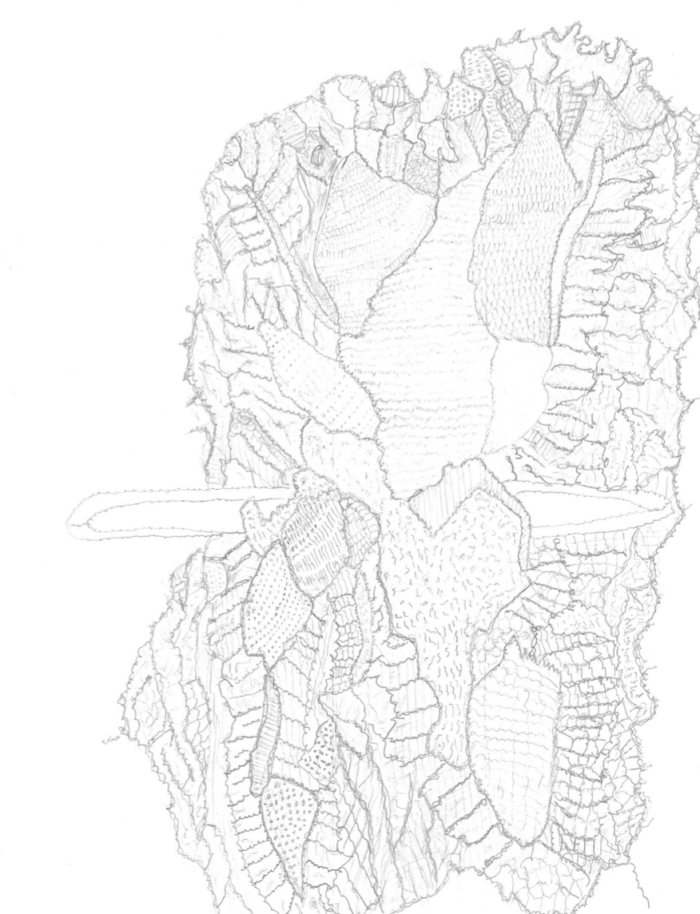
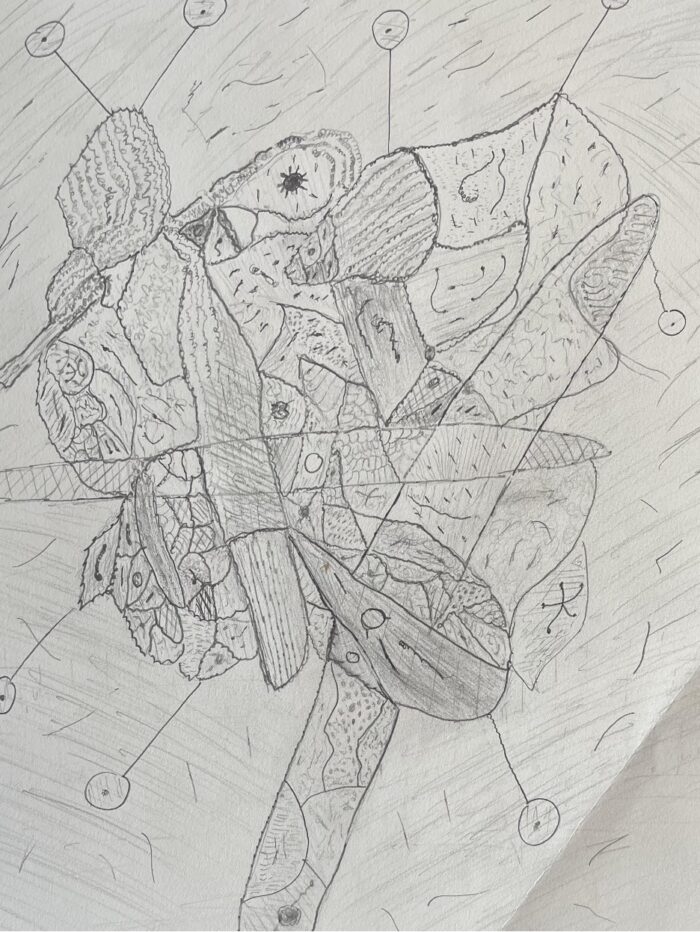
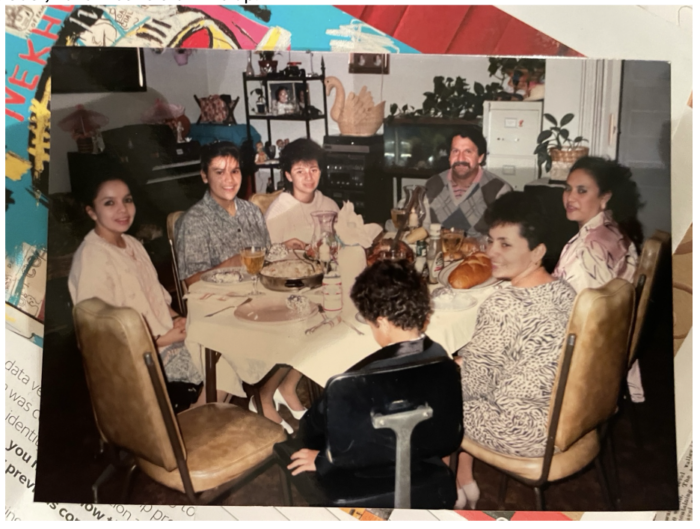
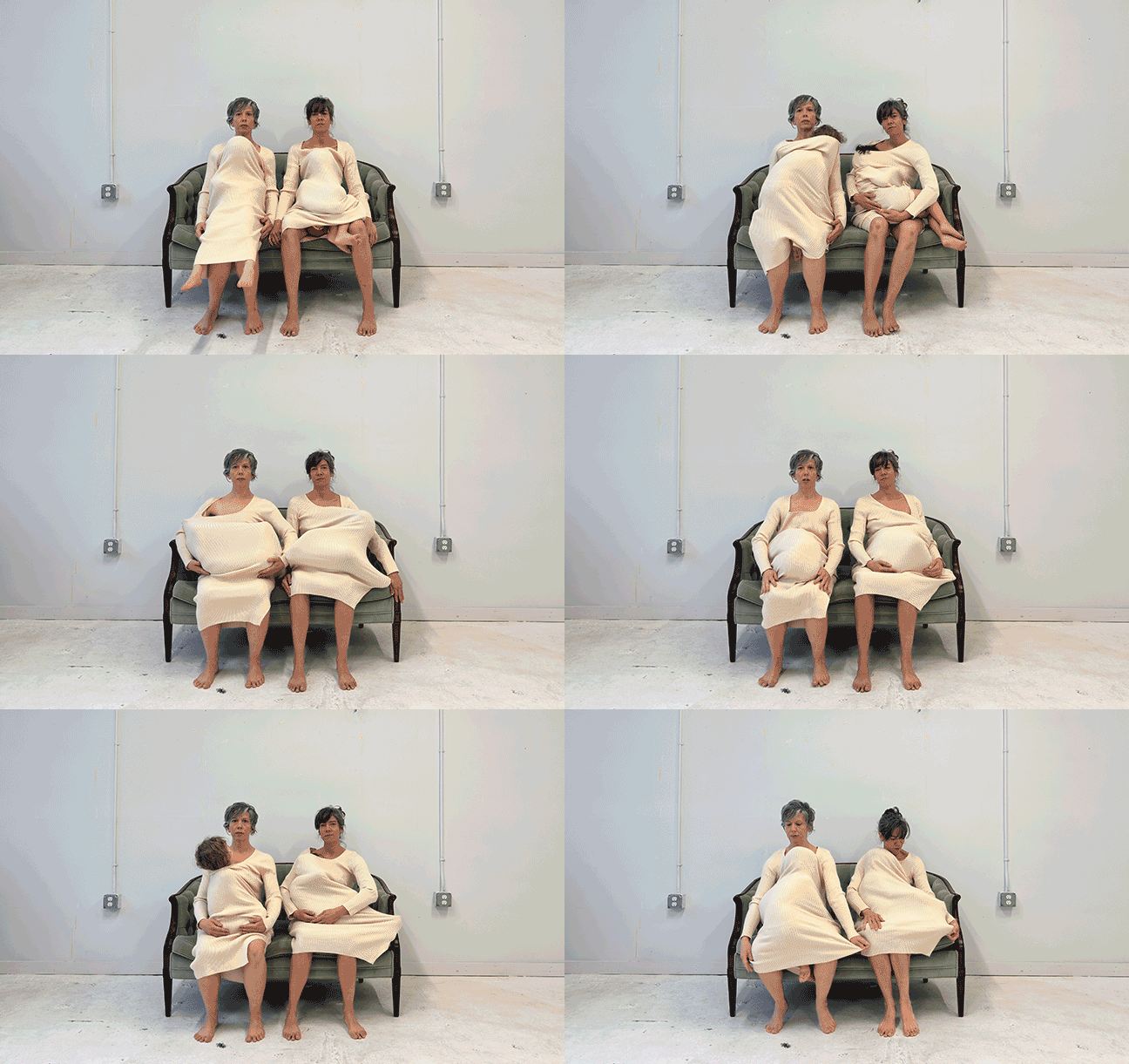
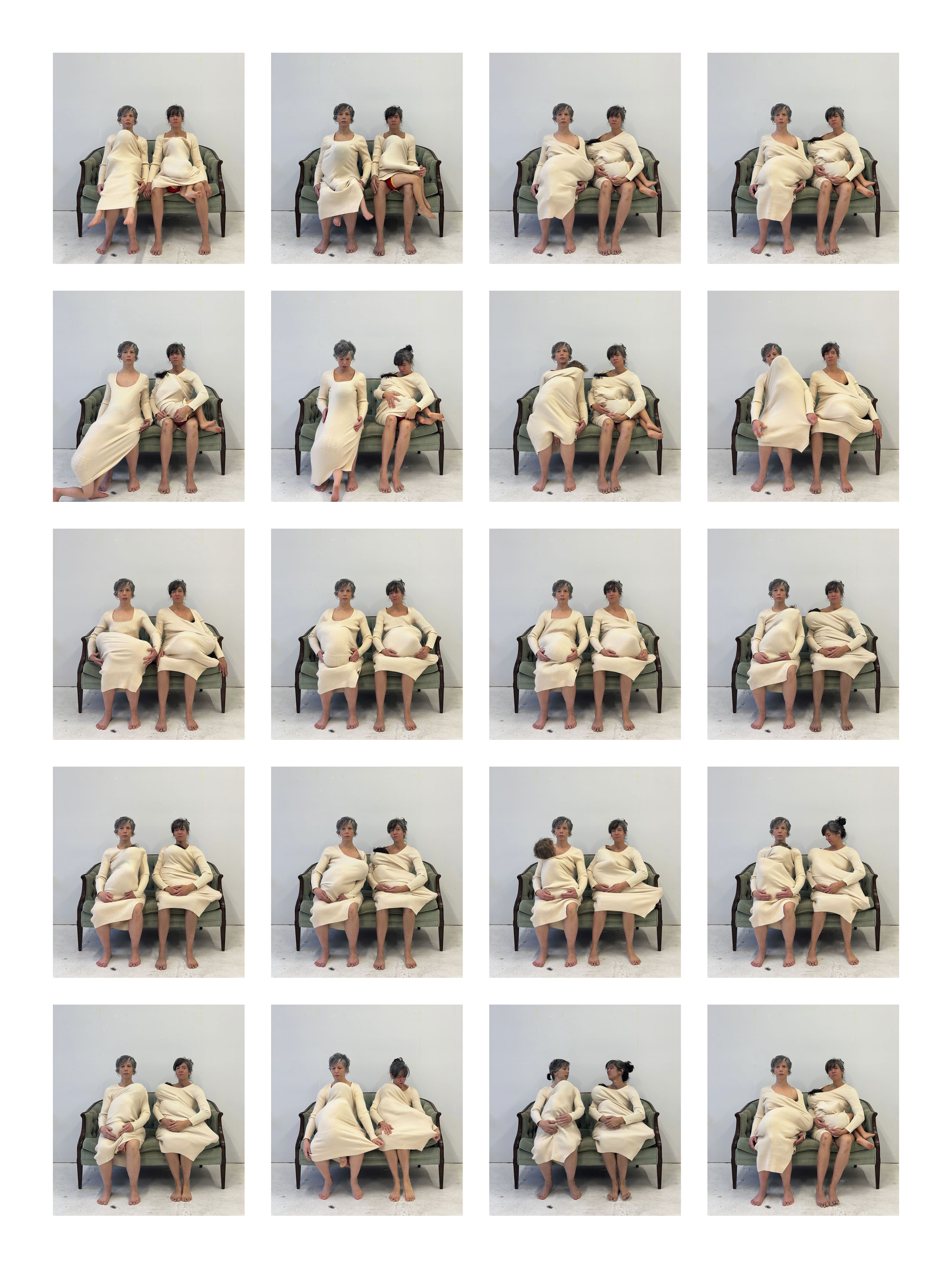
Much of Las Hermanas Iglesias’ recent projects are conceptually anchored by the biological phenomenon of microchimerism. People who have been pregnant host at least three unique cell populations—their own, their gestational parents, and any children they have carried. Inspired by this internal state of collectivity, our projects are imbued with the poetics of chimera: porous, without boundaries, and created together.